From Badge to Building: How PACS Integrators Support the Full HSPD-12 Credential Lifecycle
- kate frese
- May 19
- 5 min read

In federal physical access control procurements, HSPD-12 is more than a compliance checkbox — it's a signal. It tells Contracting Officers (COs), security managers, and technical evaluators that the bidder understands identity proofing, credential issuance, system integration, and auditability across the full lifecycle of a PIV credential.
Too many 'security contractors' can talk about cameras, doors, and panels, but can't speak to PIV enrollment workflows, middleware and certificate-based authentication, integration between PACS and enterprise identity systems, or audit logging that stands up to RMF expectations.
1. Why HSPD-12 Matters in PACS/ESS Solicitations
HSPD-12 established a government-wide standard for secure and reliable identification for federal employees and contractors. In practice, it drives the adoption and lifecycle management of PIV (Personal Identity Verification) credentials. For PACS/ESS solicitations, this shows up in requirements like PIV authentication at access points, certificate validation and revocation checking, separation of duties and enrollment controls, audit trails, and integration with enterprise identity systems.
When an opportunity references HSPD-12 — explicitly or implicitly — evaluators are looking for vendors who understand that identity is the root of physical access trust.
2. The Credential Lifecycle: 'Badge to Building' Is a System, Not a Step
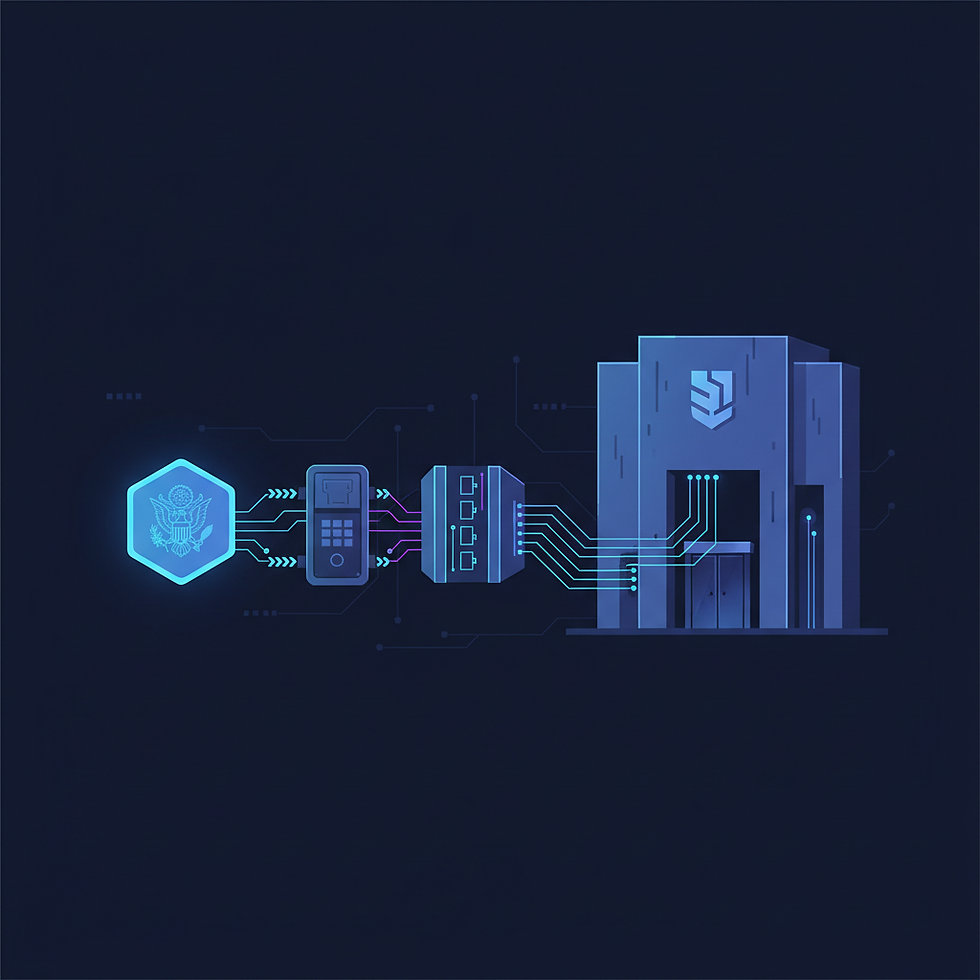
A PIV credential lifecycle includes more than issuing a badge. A PACS integrator's value is in ensuring the end-to-end system works reliably and securely across: identity proofing and enrollment; credential issuance and activation; middleware and certificate-based authentication; PACS enrollment and access provisioning; door controller integration; audit logging, monitoring, and reporting; and lifecycle operations including updates, revocation, replacement, and termination.
A mature integrator designs for the full lifecycle from day one — because retrofitting lifecycle controls after deployment is expensive and disruptive.
3. PIV Enrollment: Where Trust Begins (and Where Projects Fail Quietly)
PIV enrollment is the front door of the trust model. It includes identity proofing, collection of biometric and demographic data, issuance steps that establish cryptographic identity, and activation procedures. Even when the integrator isn't the issuer, COs care whether your solution respects the chain-of-trust, supports enrollment workflows, and avoids weak workarounds that create audit findings later.
A PACS integrator supports enrollment by designing workflows that connect issuance to PACS provisioning cleanly, ensuring enrollment data maps correctly to PACS identities with no duplicates, supporting secure administrative roles and separation of duties, and documenting the process so it's repeatable across sites and turnover.
4. Middleware: The 'Invisible Layer' That Makes PIV Work at the Edge
Middleware is often where implementations get brittle. It's the layer that helps systems interpret and validate PIV credentials and certificates — the difference between 'PIV works in the lab' and 'PIV works at every door, every day, under real operational conditions.'
Evaluators look for clear compatibility statements across readers, controllers, and software versions; a plan for updates and patching; and a troubleshooting model that doesn't rely on tribal knowledge. Blue Violet Security differentiates by treating middleware as a managed security component — not an afterthought.
5. Door Controller Integration: Where Architecture Meets Reality
Door controllers are where enterprise policy becomes physical behavior. Integrators must ensure reader-to-controller wiring and configuration is correct, controller-to-PACS communications are secured and resilient, fail-safe/fail-secure modes align with facility policy, time synchronization is correct (critical for audit logs), and offline behavior is understood.
COs care less about brand names and more about outcomes: Can the system enforce PIV-based access consistently? How are exceptions handled? What's the plan for phased cutovers without locking people out? How do you prove the system works after acceptance? A capable integrator provides a commissioning and validation plan with test cases, acceptance criteria, and evidence capture.
6. PACS Enrollment & Provisioning: Identity Meets Authorization
A PIV credential proves identity. The PACS must still decide authorization—what doors, what schedules, what conditions. Good provisioning means role-based access groups, time-based schedules aligned to policy, least privilege access, and a clean joiner/mover/leaver process, especially for contractors.
Key integration points include directory services and identity stores, HR or contractor management systems, and visitor management systems. Even when owned by different stakeholders, the integrator's job is to make the end-to-end flow coherent and auditable.
7. Audit Logging: The Differentiator That Wins Evaluations
Audit logging is where 'security theater' gets exposed. A federal PACS/ESS solution must answer: Who accessed what, when, and with which credential? Who changed permissions? Were there failed attempts, forced doors, or tamper events? Can logs be exported for investigations and compliance reviews? Are logs protected from alteration?
A strong integrator delivers a logging architecture, a time sync strategy so events are trustworthy, role-based admin logging, reporting templates aligned to inspections, and a plan for log review—not just log collection. Generic contractors stop at 'the system logs events.' RMF-aware integrators explain how logs support continuous monitoring and how the solution reduces risk and supports authorization decisions. That's the difference between 'installed' and 'defensible.'
8. What COs Evaluate in PACS/ESS Solicitations
When COs and evaluators review proposals, they score for technical approach (architecture, integration plan, cutover strategy), security posture (credential lifecycle, admin controls, auditability), operational readiness (training, sustainment, SLAs), compliance alignment (HSPD-12, PIV usage, security documentation), and risk management (how you reduce outages, lockouts, and audit findings).
Proposal language that signals competence: 'Credential lifecycle support from enrollment to deprovisioning.' 'Certificate validation and revocation checking approach.' 'Commissioning and acceptance test plan with evidence capture.' 'Audit logging for access events and administrative actions.' 'Sustainment plan: patching, updates, configuration management.'
9. Implementation Blueprint: A Lifecycle-First Plan
Phase 1 — Discovery & Architecture: current-state assessment, identity and credential workflow mapping, network and logging architecture design, cutover strategy and risk register.
Phase 2 — Build & Integrate: controller and reader configuration standards, middleware configuration and validation, PACS provisioning model (roles, schedules, zones), logging configuration, retention, and export testing.
Phase 3 — Commission & Accept: test cases for PIV auth success/failure, revocation and replacement scenarios, offline/network-loss behavior validation, evidence package for acceptance.
Phase 4 — Sustainment: change control and configuration management, patch/update cadence for software components, training for admins and operators, continuous monitoring and audit support.
Conclusion
HSPD-12 is not just a badge standard — it's a lifecycle discipline. Federal PACS/ESS programs succeed when integrators can support the full chain from PIV enrollment and middleware to door controller integration and audit logging — while communicating in the language evaluators care about: risk, compliance, and operational readiness.
Blue Violet Security differentiates from generic security contractors by delivering lifecycle-first integration and RMF-aware documentation that reduces lockouts, audit findings, and long-term sustainment cost — exactly what COs are evaluating in serious PACS/ESS solicitations.
Blue Violet Security, LLC is a veteran-owned small business with SDVOSB certification in routing, specializing in federal physical security integration aligned to FIPS 201-2, NIST 800-53, and UL 2050 standards.
Legal Disclaimer: The information provided in this white paper is for general informational purposes only and does not constitute legal, regulatory, or compliance advice. Federal regulations, directives, and standards — including HSPD-12, FIPS 201-2, and NIST SP 800-53 — are subject to change. Organizations should consult qualified legal, security, and compliance professionals before making procurement or implementation decisions based on this content. Blue Violet Security, LLC makes no representations or warranties regarding the accuracy or completeness of this information.
Comments